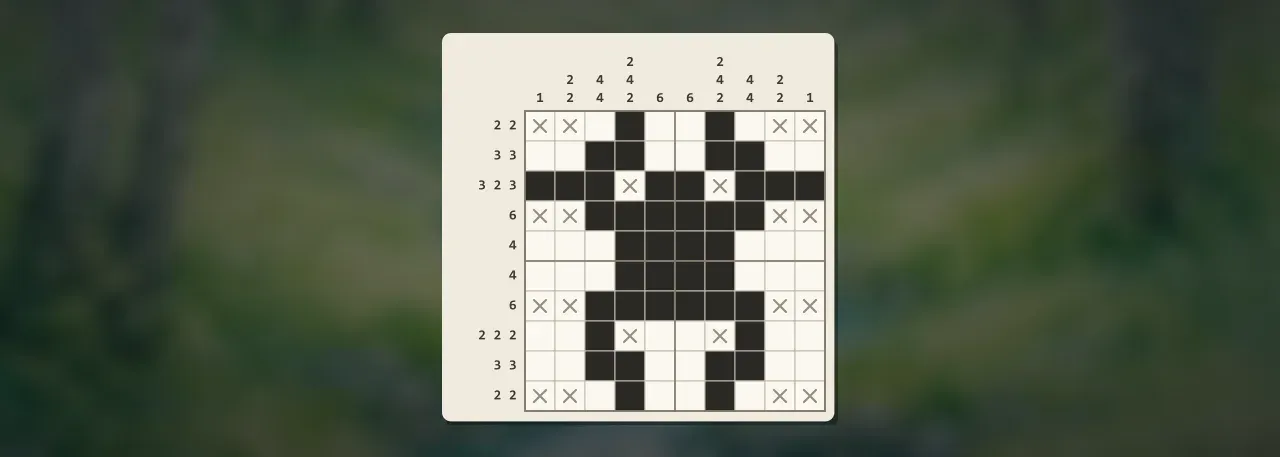
An × versus a blank cell
A blank cell is undecided: it could still turn out filled or empty. An × is decided. Both end up empty in the finished picture, which is why some players skip marking, but only the × carries information. A blank tells you nothing about where a block can or cannot sit.
In Nogramix, choose the Mark tool, or right-click with a mouse, to place an ×.
When you can place an ×
Only when a clue proves the cell empty. Four situations cover most cases. The first three lines below are real rows from Petal, a 10×10 Spring Forest puzzle.
1. The clue fills the whole line. When the numbers plus one gap between each pair add up to the line length, every gap is known from the start.
| 3 2 3 | × | × |
|---|
2. The line is finished. Once every block of the clue is in place, every cell left over is empty.
| 6 | × | × | × | × |
|---|
3. No block can reach the cell. If every placement of every block misses a cell, it is empty. Nonogram techniques beyond overlap covers this in depth.
| 2 2 | × | × | × | × |
|---|
4. The clue is 0. The line has no filled cells, so every cell in it is ×. No Spring Forest board has a 0 clue, so this line is an illustration.
| 0 | × | × | × | × | × |
|---|
One more source of × marks appears on harder boards: a contradiction check that proves a cell cannot be filled. See the contradiction technique.
Why marking matters
Every × is a wall. Walls shorten the space a block can slide in, which creates new overlap cells and new out-of-reach cells in the crossing lines. The Nonogram overlap technique shows how two × marks at the ends of a row turn a clue with no overlap into two guaranteed cells.
Common × mistakes
- Marking a cell because it is probably empty. An × must be proven. An unproven × is a guess, and it can mislead every line that crosses it.
- Leaving proven cells blank. If you know a cell is empty and do not mark it, you will have to work it out again, and the crossing line cannot use it.
- Forgetting the crossing line. Each new × belongs to a row and a column. Re-read the other one; it often has a new deduction.
- Reading an × as a clue. Marks are your own notes. They never change the clues or the solution.
New to Nonograms altogether? How to play Nonograms explains filling and marking from the start.